Bye rotations have become increasingly rare in college gymnastics, with teams often citing meet length and TV restrictions as the reason for eliminating meets with more than four teams. The last two seasons in particular saw this play out with the SEC championship, where one team was excluded in 2025 to avoid needing a bye rotation, but the bye rotation was added back in for 2026 after backlash. With this change, we wanted to know whether these bye rotations impact the gymnasts’ performance. Does the extra rest help boost performance? Or does the bye cause gymnasts to get cold and out of the flow of the meet? We dove into the data to find out.
Methodology
To evaluate the impact of bye rotations, we collected data from 23 meets between 2024 and 2026 that included five or more teams with rotation order data readily available. We labeled each event score as either coming after a bye or not. The starting event was never labeled as coming after a bye, even if that event came after the bye for every other team at that meet. However, the first event for a team that started on a bye was considered coming after a bye since there would be an extended period of downtime after warmups. Finally, we took the difference of those scores versus the team’s NQS for the season to normalize for a team’s regular scoring potential. Note that the NQS calculation was different in 2024 and 2025 vs 2026.
Twelve of the meets we analyzed had five teams and one bye rotation. Seven of which the bye rotation was between vault and bars, three between beam and floor, and two between floor and vault. Interestingly, only two meets out of the 23 had a bye before beam, even in the case of seven-team meets with three bye rotations. This trend of not putting a bye before beam could imply a belief that going after a bye makes performance worse, and therefore not wanting to go to a risky event like beam after a bye rotation.
Results
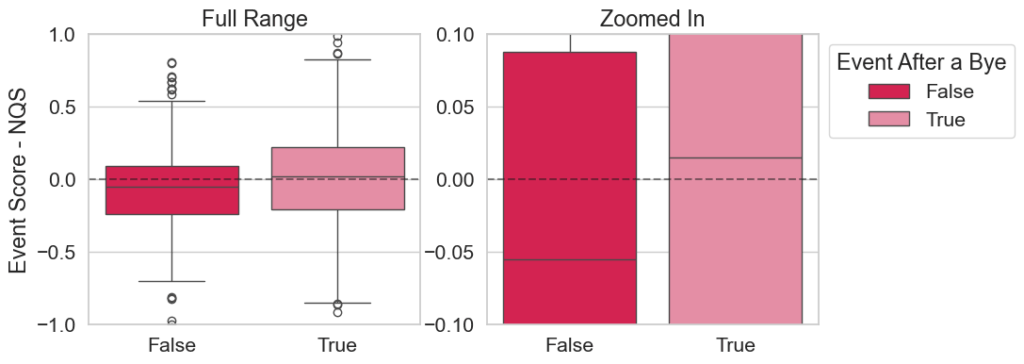
The data we looked at goes against the belief outlined above. Events that came after a bye actually scored slightly higher compared to a team’s NQS than events that did not come after a bye. From the zoomed-in chart, we can see that the median score is approximately half a tenth lower than the team’s NQS, while the event after a bye was around a quarter tenth higher.
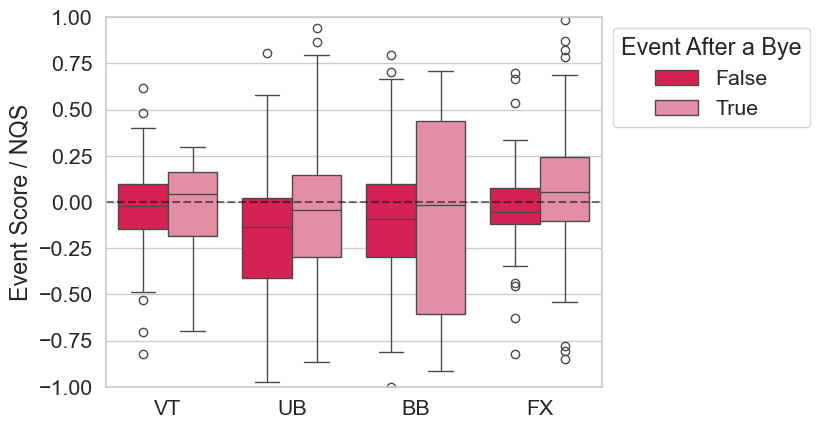
Breaking down the difference by event shows a similar trend, where the event scores after a bye are higher than when they come directly after an event. As a reminder, beam data was very sparse here, as it rarely comes after a bye rotation, resulting in a very wide distribution.
Finally, we compared the team that started on the event to all other teams at the same meet who competed on that event after a bye, but found no evidence one way or another to say which teams did better.
Overall, meets with bye rotations are rare, so there isn’t much data to answer this question conclusively. However, the data here shows a trend that teams perform slightly better going into an event after a bye rotation. This raises questions about the optimal amount of rest time between rotations to f balance rest with staying loose and warm at a meet, a question that we unfortunately do not have the data to answer!
READ THIS NEXT: Data Deep Dive: Postseason Sleeper Agents
Article by Claire Harmon and Dara Tan