Gymnastics is an all-or-nothing, all-consuming sport. To be competitive, gymnasts can’t take long breaks from practice or do it only a few months out of the year. In the 2023 NCAA Student-Athlete Health and Wellness Study, 42% of NCAA women’s sports participants responded they felt “overwhelmed by all you had to do” constantly or most every day, illustrating how widespread these pressures are across college athletics. Although getting to compete at this level is the goal, if this lifestyle is not managed properly, the dream can burn out quickly.
Historically, conversations around mental health have been stymied by stigma, specifically when it comes to high-level athletes expressing falling out of love with the sport they have been raised to do. Most college-bound and elite gymnasts train between 25 and 40 hours a week, depending on the path they are on, and after a while, these demands become overwhelming. Whether this path is training elite or looking toward the NCAA, this rigorous schedule is not only physically demanding, but mentally and emotionally challenging as well.
In NCAA gymnastics, though athletes train for fewer hours, the pressure of competition is much more intense. This is in part because in college, gymnastics becomes a team sport rather than an individual one. Where it used to be the athletes depending on themselves and their own performance, now 20 others are depending on them to do well each week. Fans of the sport get more involved and put stock into these athletes doing well, and even if the intentions are good, the expectations can also add to the burden.
Academics also get more challenging. The ‘real world’ is getting closer, having a high GPA is more important than ever before, and what life is going to look like when these four years are over weighs heavily. According to the NCAA Student-Athlete Health and Wellness Study, “academic worries” and “planning for the future” were the most frequently reported factors negatively affecting mental health among women’s sports participants.
In the last five years, the conversation around mental health has become one that athletes are more comfortable having. In recent years, several gymnasts have been very open about their mental health. Oftentimes, the stories they share are centered not only around the experiences they have had that drove them to lose the love of the sport, but also how NCAA gymnastics has allowed them to get to the point of healing their relationship with the sport before closing the chapter.
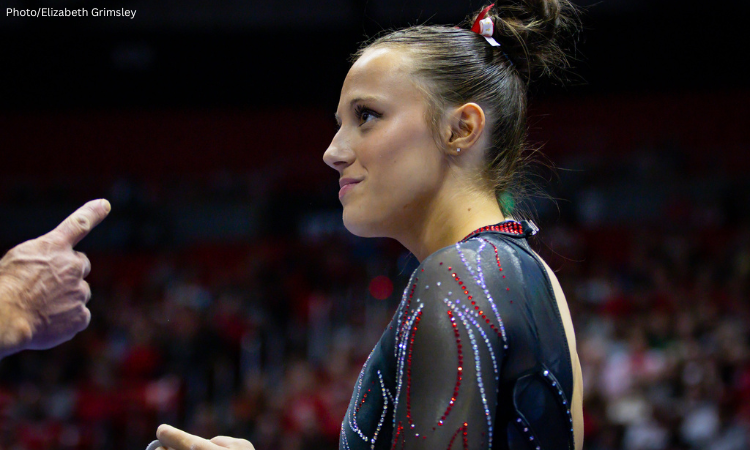
Utah junior Ella Zirbes has had one of the most public stories related to dealing with mental health and how it affected her gymnastics career over the past few seasons. Starting gymnastics at two, progressing quickly through the sport, and getting to the elite level by 11, Zirbes knew her future of being a Utah Red Rock by the time she was 13. Before the NCAA rule change in 2018 prohibiting early commitments, athletes were allowed to commit to collegiate programs at any age, and knowing where they were going to college before starting high school was not uncommon. Now, athletes must wait until at least their junior year of high school to make an official commitment to a program.
“When I was young, gymnastics was all I wanted to do,” shared Zirbes. “[Gymnastics] started to feel more like a chore when I began elite. There is so much pressure on your body and brain, and the long hours in the gym made it more difficult. … Anxiety had popped up before in my career, but when I dropped back to level 10 before coming to Utah, I realized, this is something I am supposed to be enjoying. … Coming in freshman year, I was excited for gymnastics at this new level. When you are in club, it can feel like the same thing every day, so I really appreciated the switch [and it being more] about team focus.”
Zirbes consistently competed in lineups her freshman season, and moving into her sophomore year, she held herself to even higher standards than the year before. “There was more pressure going into sophomore year, and I think that’s why I had more anxiety last season,” Zirbes explained. “It wasn’t pressure from anyone else; it was pressure I was putting on myself. I wanted to keep getting better, and now I had a year under my belt. I also wanted to help lead the team more, so I was putting so much on myself all at once.”
Athletes in general hold themselves to a high standard, but for gymnasts specifically, perfection is demanded at such a young age, resulting in more pressure early on. Suddenly, the thing you once loved the most becomes the thing that causes you the most stress. How does that just happen?
“I first noticed [anxiety] in my first meet of my sophomore year in 2025. I wasn’t enjoying myself as much as usual. I didn’t have any big anxiety attacks, but I remember looking around and thinking ‘all this is kind of scary’. I kept thinking, ‘look at how many people are watching me, my stomach’s starting to hurt, I don’t know if I can do this.’ All these feelings of self-doubt started [creeping in]. It was at the next meet where I broke down mid floor routine.” Zirbes shared that this attack stemmed not only from the pressure she was putting on herself, but the way she began to care so much about what the people watching her thought. As the season progressed and these feelings continued to present themselves, Zirbes explained the fear of this mid-floor-routine attack happening again essentially willed it into existence. “[Head Coach] Carly pulled me aside and asked me what was going on, that I looked upset and I was, but I didn’t know how to solve it.”
Part of the reason the topic of mental health holds so much weight is that people feel shame or fear around these emotions, or because they feel like they are alone and have no one to talk to about it. While not every athlete speaks publicly about their mental health, anxiety is widespread among women’s sports participants. The NCAA Student-Athlete Health and Wellness Study found that 29% reported feeling overwhelming anxiety constantly or every day. For Zirbes, speaking about it is the exact reason she was able to fight her way out of this anxiety. When she started experiencing anxiety related to competition last season, she was asked to do an interview as she started learning how to cope with what was going on.
“I wanted to share what was happening so people would know and wouldn’t judge me,” said Zirbes. “It was definitely a risk, especially with talking about anxiety and mental health, you never know how people are going to respond. … Now this wasn’t something I was trying to hide, everyone knew and it made it feel less big.” Zirbes attributes her ability to make headway in dealing with her mental health struggles to her ability to talk about it, thus taking the power out of it, and also that she was surrounded by a support system that made this something she could manage. “My coaches were great when this was all happening, I don’t know what I would’ve done without them. … [Together the coaches and I] made a plan and [they] left it up to me with what lineups I thought I could handle. … I slowly built my way back into floor when I was ready, but being able to open up to my coaches, talking to a sports psychologist and being able to share what I was feeling and ask for help made a big difference.”
When the initial article came out about Zirbes, her social media was flooded with messages from and about people who had experienced the same thing. Current and former athletes, as well as parents of athletes who watched their own gymnasts struggle, all shared how her story and vulnerability impacted them. “[Hearing] from all these people showed me I’m not the only one,” said Zirbes. “I might be the only one on this big of a stage right now [talking about it], but hearing other people going through or having gone through something similar really helped me. It helped build up my confidence and showed me this feeling was bigger than me and allowed me to be an advocate for mental health in gymnastics.”
Zirbes shared that during the Sprouts Quad, the Utes’ first big competition of the season, two-time Olympian Aly Raisman came up to her and shared she had experienced anxiety in her own career, and how great Raisman thought it was for her to talk about it. “[This] made me feel so special that I was able to touch so many people in talking about it. It [emphasized] I wasn’t alone in these feelings, and that everyone experiences something like it.”
Zirbes is still learning to cope with these emotions and is getting back to where she was when she was younger and only ever wanted to do gymnastics. Entering the back half of her NCAA career and with this chapter of her life coming to a close, Zirbes is returning to the love she always had for the sport, emphasizing gratitude for how she has healed this relationship.
“Gratitude cancels out my nerves. If I get nervous before my floor routine, I tell myself, I am so lucky to be here on this team, to have my body healthy enough to do this, and to have all these wonderful people around me,” Zirbes shared. “… [I’ve been] getting back to this place of loving gymnastics like I did when I was young when I realized how much time I had left. I’m already halfway done with college, this thing I had been doing my whole life is coming to an end, and I want to enjoy it. I want to be able to look back and have so much fun, to stay in the moment and take everything in.”
NCAA gymnastics gave Zirbes back what anxiety took away from her. Although these feelings showed up during her collegiate career, she’s found that turning to her teammates, surrounding herself with strong support, and learning to ask for help has brought her back to a place where she could fall back in love with the sport like she first did 20 years ago.
“My anxiety isn’t fully gone, it’s still something I have to fight through every now and then, but I have gotten back to that level of enjoyment,” said Zirbes. “Pressure is a privilege, and it goes along with the gratitude [I feel]. Thinking about how blessed [I] am to do this, even though it’s difficult to see that in the moment, that is what I wish I could tell myself looking back on last year. It’s normal to feel the feelings, but learning how to feel it, and also learning how to diffuse it is so important.”
READ THIS NEXT: With a Transformed Team, Maryland Looks to the Season Ahead
Article by Julianna Roland