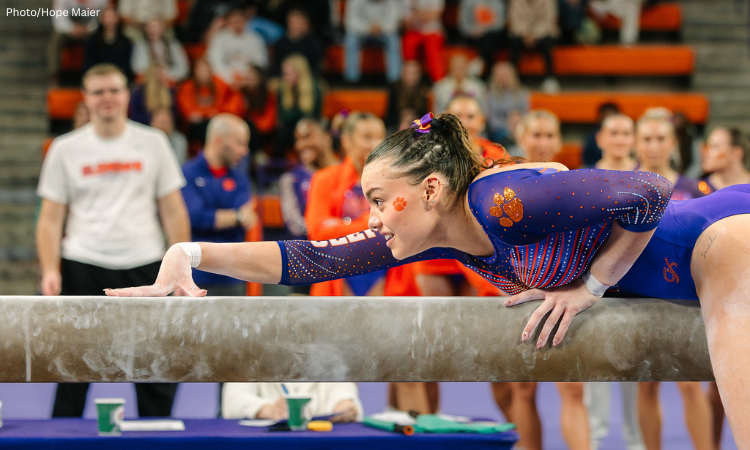
We’ve heard commentators talk at length about how the beam is only four inches wide. We’ve seen teams shuffle through multiple options in the leadoff spot to find the combination that best keeps the rest of the lineup’s nerves at bay. We’ve seen athletes with over a decade of experience fall on seemingly simple skills. To the average person, beam may seem like the riskiest event, the one where even the tiniest of missteps can end in disaster, but is there any data to support it?
There are many reasons why scores on a certain event may trend lower. Start value is a somewhat common reason that doesn’t correlate to risk. However, an event’s susceptibility to falls and mistakes can definitely be seen as risky. For this analysis, we started with all meet results from the top 36 teams from last year to try and eliminate routines that weren’t intended to start from a 10.0 start value (or a 9.95 in the case of vault). We then found the percentage of routines that scored below 9.5, 9.7, and 9.85. Scores below 9.5 typically indicate a fall or multiple large errors, a 9.7 is indicative of a possible large error, while a 9.85 is considered an excellent routine with only minor form errors.
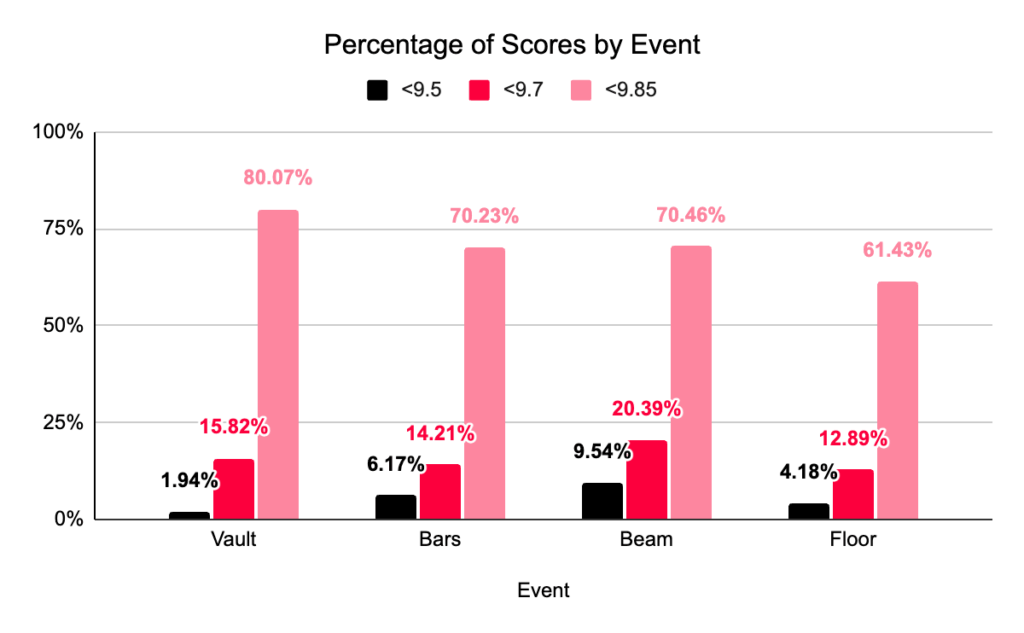
Beam does seem to have a higher proportion of routines that score less than 9.5 and 9.7, which could indicate that large errors like leg-up wobbles, grabbing the beam, and falls are more common on beam than other events. However, vault has the most routines below 9.85 of any event, which could mean that vault is more prone to minor form deductions, but I would likely attribute that difference to the fact that 9.95 start values are still quite common on vault as opposed to the other events. Despite falls and mistakes being seemingly more common on beam, excellent routines are just about as likely to occur as on bars.
Next, we wanted to see if there was an event where multiple falls or major mistakes were more common, so we looked at the number of routines that scored below 9.0 and 8.5.
| Event | # Routines <9.0 | # Routines <8.5 |
| Vault | 9 | 4 |
| Bars | 72 | 18 |
| Beam | 62 | 7 |
| Floor | 55 | 12 |
Unsurprisingly, vault had the least amount of routines that fell into this category due to vault being only a single skill. Bars actually had the most routines under 9.0 and 8.5, not beam. This could be due to multiple falls, but due to the nature of bars, it’s also possible that these lower scores came from a mistake that resulted in a missed connection, a start value issue, an extra swing deduction, or a combination of all three. Bars is an event where resetting after a mistake can be extremely difficult because the gymnast is constantly moving, so there’s certainly a risk factor involved, particularly if a routine is constructed with a lot of required connections.
Next, we looked at the lowest scores on each event to identify any obvious differences. Beam had the highest at 8.35, followed by vault at 7.6, and bars at 5.075. Any fan who has ever seen a season-ending injury occur mid-routine won’t be surprised to hear that floor is the event with the lowest score of only a 3.55. Although injuries can occur on any event, vault, beam, and bars typically only include one hard landing at the end of the routine, while floor has two or three. If an injury occurs on the first pass and the gymnast can’t continue, then the routine is still scored based on whatever requirements were completed, resulting in the possibility for extremely low scores.
For our final analysis, we looked at the mean, median, and interquartile range on each event to see if there was a particular event that had a larger range indicating less consistency in scoring or a lower mean indicating lower scores on the event overall. Each box represents the middle 50% of routines, the line through each box represents the median, and the X represents the mean. Please note that outliers were not included in the boxplot for ease of visualization.
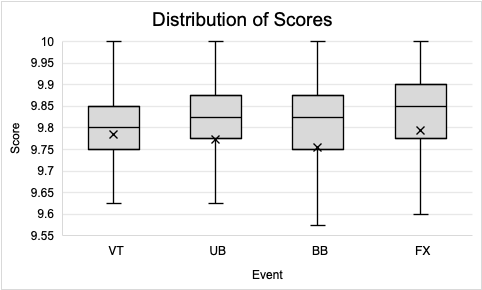
The interquartile ranges were all within 0.025 of each other, which is smaller than the amount of a single deduction and is therefore likely not of significance. Of note, vault had the second-highest mean but the lowest scores at both the 75% and 25% benchmark. This is once again likely caused by the start value differences on vault. The Yurchenko full is still by far the most common vault in college gymnastics, so although vault is just one skill and therefore may incur less obvious deductions, most of the routines in the middle 50% automatically start 0.05 lower than any routine with a perfect 10. I wouldn’t say the start value differences on vault make it inherently a risky event, but there’s certainly strategy involved in deciding whether to settle for a lower start value vault with less room for error, or a more difficult vault with a blind landing or higher probability of sitting it down.
So, is beam the riskiest event? There’s data to back up that claim, and we think it’s the most obvious option, but a case could be made for every event depending on what one might view as risky.
READ THIS NEXT: Data Deep Dive: Which Event Mattered Most This Season?
Article by Mariah Dawson

![[Leotard Rankings: Best of 2026] graphic](https://collegegymnews.com/wp-content/uploads/2026/04/Leotard-Rankings-2026_WP-420x300.png)