
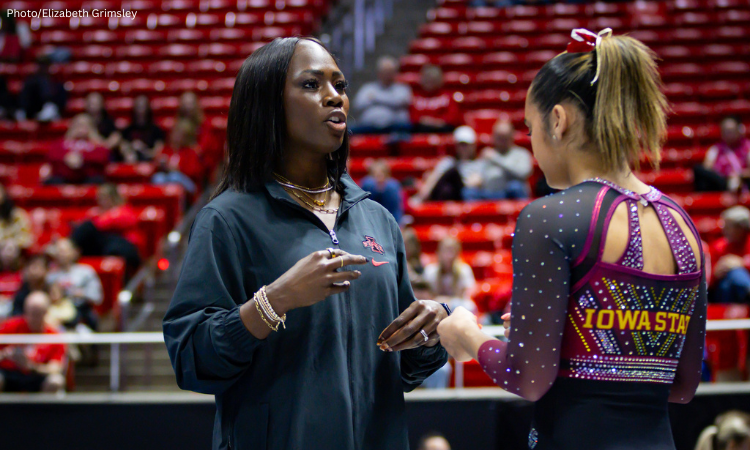
On March 3, Iowa State University Endowed Director of Athletics Jamie Pollard announced the discontinuation of the school’s women’s gymnastics program.
For those who had followed the turbulence surrounding the team in recent weeks, the decision was not unexpected. Program cuts, while painful, are not new in collegiate gymnastics. What stands out in this case is not simply the outcome, but how it was communicated.
There may be no easy way to eliminate a varsity program. But transparency, consistency, and accountability matter—and in this case, those elements were often unclear.
A Shifting Explanation
The sequence of events raised questions almost immediately.
Feb. 5: The program announced the cancellation of a scheduled meet against West Virginia, citing an inability to “safely field a team.”
That explanation puzzled many within the gymnastics community. Unlike head-to-head sports, gymnastics does not require a full roster to compete. Teams can—and occasionally do—participate with limited lineups. In 2018, Arizona competed with severely reduced numbers against Oregon State. Earlier this season, Wilberforce fielded four athletes per event in a meet against Western Michigan.
While competing short-handed is not ideal, it is not unprecedented—nor inherently unsafe.
Feb. 8: Senior Associate Athletics Director Shamaree Brown announced the cancellation of the remainder of the season, again citing insufficient available athletes to compete safely.
In the days between announcements, several Iowa State gymnasts began posting on social media accounts typically used to signal transfer interest—another sign that deeper issues may have been at play.
Feb. 17: Pollard sent a letter to gymnastics alumni, later shared publicly, stating that the season ended because of “complex internal conflicts” involving athletes, coaches, and parents. He described “recurring conflict” as unique among Iowa State’s 18 varsity sports.
March 3: Pollard formally announced the program’s discontinuation. In a video message, he again referenced “unresolvable conflicts” and alluded to similar issues in prior years, including a 2018 review and staffing changes in 2023.
By that point, the stated rationale had shifted significantly from “safety” to longstanding cultural concerns.
The evolving explanations created confusion. If internal conflict was the central issue, why was that not communicated more clearly from the outset?
Inconsistent Reasoning for Season Cancellation
Iowa State’s athletic department cited “safety” concerns as the reason for canceling the remainder of the gymnastics season, but that explanation did not make sense given the realities of collegiate gymnastics. Later statements suggested the underlying issue was “unresolvable conflicts” among athletes, coaches, and parents. Why did the department give a flimsy excuse in the first place? Wouldn’t it have been better to provide limited comment rather than mislead the public?
Questionable Coaching Decisions
Pollard claimed “comparable challenges have occurred multiple times in our program’s history.” If this is true, it’s difficult to understand why someone with no collegiate coaching experience would be hired to lead a program facing persistent challenges. While the assistant coaches hired in 2023 brought collegiate experience, both left in 2025, and only one of the three subsequent replacements had paid collegiate coaching experience. It feels like the program was intentionally set up for failure rather than success.
Lack of Support and Underinvestment
K.J. Kindler, Oklahoma’s current head coach, who has led the Sooners to dynastic success over the past two decades, guided her alma mater, Iowa State, to its greatest achievement ever, reaching the Super Six in 2006 before moving to Norman. At the time of her departure, Pollard—then at the end of his first year as athletic director—said that Kindler left because she wanted a new practice facility and the athletic department could not meet her timeline.
Alumna and former assistant Haylee Young noted the team had trained in the same facility for more than 30 years, lacking modern amenities such as air conditioning and trampolines under the pits. Following the elimination announcement, Kindler said:
“This outcome follows a troubling pattern of chronic underinvestment, unsafe and inadequate facilities, and a failure to provide the consistent oversight and care that student-athletes deserve.”
Former Cyclone Hannah Loyim also reported reaching out to the athletic department for support and receiving no response.
I’m not naive; I know gymnastics is an expensive sport, and upgrades may not have been in the budget. Iowa State’s 2025 financial report states that the gymnastics program cost $1,689,633 with revenue of $287,392, implying a deficit of more than $1.4 million for a single season. I find it hard to believe that money played no role in this decision, and it would have been an easy excuse to give when eliminating the program. Why instead did Pollard choose to shift blame entirely onto the athletes, coaches, and parents, saying specifically the decision was not made because of financial reasons?
Accountability at the Top
I refuse to believe there is something uniquely difficult about running a collegiate women’s gymnastics program, which seems to be what Pollard is implying when he throws up his hands in defeat after experiencing “challenging issues” across multiple coaching staffs and completely different sets of athletes. If that were the case, surely we would hear about similar “issues” arising in other programs around the country. Instead, women’s collegiate gymnastics is thriving.
A real leader of an athletic department takes responsibility for everything that occurs in their programs, so I find it shocking that he is willing to publicly throw athletes under the bus for what is ultimately a failure in leadership.
A Call for Transparency
The Iowa State athletic department owes the entire gymnastics community—athletes, alumni, coaches, parents, fans, and media—an honest, introspective investigation into its own shortcomings that led to this situation. I do not wish to absolve any athletes, coaches, or parents of any part they legitimately played in whatever these extremely vague “issues” may be, but it feels disingenuous for Pollard and the rest of the department not to take any responsibility for the role they have played in the program’s downturn since Kindler left.
While program cuts will always result in heartbreak, backlash, and criticism, there was a way to end this program while preserving its dignity and proud history—and this was not it.
READ THIS NEXT: Jeffrey Langenstein on Crafting Floor Routines That Count
Article by Jenna King



Thank you for this. My immediate reaction to this whole situation was that they were going to use it as an excuse to cut the program. And when they did that and gave their explanation, my next reaction was that if what they’re outlining happened is the reason, then the blame falls squarely on the athletic department failing to fix it.