NCAA gymnastics is no stranger to viral moments. More often than not, these moments come from a floor routine that makes waves not just within the gymnastics community, but across social media as a whole. Each year, there are new attention-grabbing routines, like Jordan Chiles’ Tina Turner-inspired routine this season, or the handful of Hamilton floor routines that caught the eye of the Broadway cast. While the goal might not be to go viral, creating something memorable and unique is a priority for choreographers so they can allow their athletes to truly shine.
Choreography plays an essential role in the performance and artistry requirements of gymnastics as well as audience engagement, and is usually what fans look forward to the most. The choreographer puts a great deal of thought into the choice of music, the style of dance, and what each individual athlete needs to do to succeed. They are not only responsible for checking the entertainment box and making sure the athlete enjoys performing their routine, but also for ensuring that a number of artistic requirements are fulfilled, such as full body engagement and fluidity throughout rather than simply posing, using the full floor, and choreographing expression into the dance, as outlined in the code of points.
Over the years, there have been several coaches and choreographers who have cemented themselves as the greats in this space, with routines recognizable among any gym fan and oftentimes distinguishable by school. On the one hand, there is the unique choreography of the Oklahoma Sooners done by longtime head coach KJ Kindler. On the other are the decades of stories through movement told by Miss Val at UCLA. Rather than a phenomenon of the social media age, NCAA routines have been a longstanding highlight in the sport, and there is no sign of that slowing down any time soon. There is a new generation of coaches and choreographers rising through the ranks who have had the chance to be coached by some of these greats and are now taking what they’ve learned and turning it into a career. And with the help of social media, access to a wider audience grows year after year.
Hallie Mossett, current Stanford assistant coach and choreographer, had the opportunity to be a part of UCLA gymnastics during one of its biggest eras. Mossett learned under one of the greats that is Miss Val during her time as an athlete, but her love for dance is something that has always been there. From a young age, Mossett has loved to perform. Growing up, she was classically trained in various styles, but when it came time to pick between dance and gymnastics, she chose gymnastics. Even still, dance was never far from her heart, and remained relevant throughout her career. Mossett shares that though her club coaches implemented dance into daily practices, her choreography journey didn’t really begin until her freshman year as a Bruin.
“Miss Val was diagnosed with breast cancer at the end of my freshman year, and after that I started helping choreograph. Every year I would choreograph more, and by my senior year, I had been able to work on everyone’s routine…[When I first started] Miss Val took me under her wing, and she helped me learn the art of choreography…[Then] in my fifth year when UCLA won the national championship, I was able to choreograph some of those routines too,” Mossett said.
Texas Woman’s University assistant coach and former California gymnast Kyana George took a slightly different path to choreography. George fell in love with the desire to create beautiful moments through dance, the way she had been taught to from a young age. Her club career, and her love of dance, began at Metroplex Gymnastics when she was 11.
“Tiffany Chandler, our choreographer [at Metroplex], had me stay to watch Chayse [Capps, former Oklahoma Sooner gymnast] get her floor routine and told me to watch how she makes music move with her. [Capps] pulled you in with her dance…and I could see the impact she was going to have on everyone [watching]. Tiffany can spot a ‘floor star’ just by looking into your eyes, and she told me that I could be a ‘floor star’ with my dance. My inspiration comes from [Tiffany and Chayse], and from creating moments when the dance, music, and choreography take me to another place,” said George.
Having the passion is an essential part, but it’s only a small piece of the puzzle when it comes to creating the full routine. The choreographers have a vision for the athletes they choreograph for, but how do they make that vision come to life? Through Mossett’s journey from UCLA to LIU and now to Stanford, she has followed a similar strategy of creating a vision and then focusing on collaborating with the athlete to eventually bring that vision to the competition stage.
“I have a skeleton of what I want to do, but I always leave room to change based on the way they are moving. Maybe they did something by accident and it looks better than what I had originally. I like to work my way around their body movement…I really try to tailor the athletes’ routine to them, and I want them to like it. You perform better when you are [comfortable] in what you’re doing,” Mossett explained.
George echoes this process. She also comes to the floor with a tentative plan, but is open to changing it. She admits it isn’t always easy; when you care so much about what you do, letting go of control and not being so critical of yourself and what you have created is a difficult part of the job. “I will always have the floor pattern planned out, along with parts of the routine that I know for a fact I want in,” said George. “[However], I like to keep it open-ended because I am very hard on myself and know that I’ll feel like a failure if I have a vision in mind and it doesn’t turn out the way I imagined.”
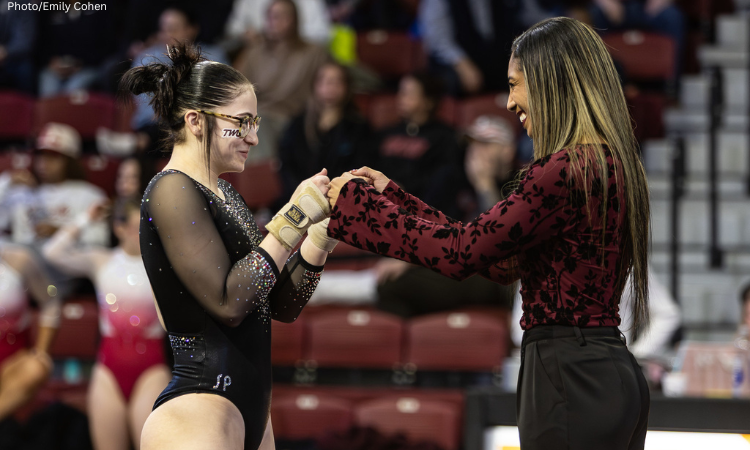
George speaks about how when she is teaching her athletes the choreography, she is right there with them, going through each step, making sure each detail is perfected, and ensuring the athlete feels comfortable and confident in what they are doing. Mossett goes about teaching her choreography the same way, but has had to overcome major challenges in order to get back to being able to do that at the level she wants. Mossett has had a total of three hip surgeries throughout her career, but the most recent one left her temporarily paralyzed during her recovery. “I would have to sit on a block and show [the girls] the choreography with just my arms, and try to do as much as I could,” Mossett recalls. “I would ask the other girls, ‘can you be my feet for a second?’ and have them show the dance as best I could describe it.” Mossett learned how to choreograph with this handicap, and now, as she heals and gets closer to regaining what her body was able to do before the surgery, the opportunity to put these pieces together and see them come to life is that much sweeter.
Putting something of your own out there is scary, and the pressure intensifies when it has the potential to be commented on or criticized week after week. Choreographers have the job of making quality routines and making each one unique. Mossett emphasizes how different the routines at UCLA were and how she is striving to provide the same diversity at Stanford. Whether it’s a lyrical routine like Ana Barbosu’s or an upbeat hip-hop routine like Sienna Robinson’s, Mossett enjoys creating pieces with different styles, and looks forward to working with each athlete and watching them grow in their performance quality and confidence over their collegiate careers.
Creating variety within a single team is a challenge in itself, but as a choreographer, you also have to make sure these routines, in both the music and the dance, stand out against other teams as well.
“I always say, if it doesn’t grab the person’s attention at the concession stand in Dickies Arena, then we are not using [that music],” says George. “[Also] if you have the same music as another gymnast, it should be ‘your music’ that they have, not vice versa…I emphasize on making [each] person in the arena be a part of the routine, other teams getting distracted by our crowd engagement with their fans, for the judges to drop their pens because each routine should be an experience for every single person in the building.” Making each routine its own statement piece is what separates those that are remembered from those that aren’t, and is one of the biggest goals of each choreographer.
Mossett, whose Beyoncé-inspired routine went viral in 2017, knows a thing or two about having a routine stand out. Beyond her success as an athlete, Mossett has been involved in some big moments in UCLA history when it comes to choreography. She collaborated with Miss Val on Katelyn Ohashi’s first Michael Jackson routine in 2018, the year the Bruins won the national championship, as well as Gracie Kramer’s infamous spooky routine that earned her her first perfect 10.0. Mossett knows how to create these big, potentially viral moments, but also emphasizes authenticity over everything else.
“When [a routine goes] viral, I was just doing what I thought was cool…When you create for the love of being viral, or if you expect to get attention for it, it can lose that authenticity factor…There are certainly things you can do to engage the audience, the judges, do a viral dance move people know, but if you lose sight of that goal to purely entertain and only want to do it for [the views], something has to change.”
George has had the opportunity to create these moments at both Alabama, where she served as a volunteer assistant coach, and at TWU in her current role. In 2023, her first year as a team choreographer, she had the opportunity to choreograph a routine for Luisa Blanco. She looks back fondly on this memory of her time at Alabama because of “the openness, collaboration, and trust we had with each other that made this one so special.” After her move to Texas Woman’s, George highlights several routines she has loved having her hand in: Sophia Isbell and Kylie Minerd’s current routines, as well as Kyleigh Ghanbari’s 2025-26 routine–the first she choreographed for the Pioneers–which features the alter ego Katalina, whom Ghanbari taps into while she’s performing.
A choreographer watching their vision come to life is a reflection of the time, energy, and love put into it by both the choreographer and the athlete. The love for dance, the passion for creating, and the opportunity to turn this into a career is the dream. “Being able to shape my career around something that I love, starting at LIU and moving to Stanford, has been something I am so grateful for,” Mossett shared, looking back on what will likely be just the start of her hopefully long career. George reflects on what she has done so far in her new role, and the memories and stories she has always wanted to create since she was young: “I have this vision in the forefront of my mind when it comes to performance quality and choreography…It’s about the little girl on the top row in the Fort Worth Convention Center watching Lloimincia Hall, Hailey Scaman, Nina McGee inspiring the next generation of floor stars through their performance. Grit and heart that was left inside those white lines, but reached the heart of the girl sitting in the top row…”
READ THIS NEXT: Leotard Rankings: Week 6
Article by Julianna Roland