Unlike in the level 10 and elite scenes, gymnasts who compete in the all-around–particularly on a consistent basis–are more the exception than the rule in college. For example, only 94 gymnasts (about 5% of rostered athletes) recorded sufficient home and away scores to obtain an NQS in the all-around last season. This is in contrast to the over 500 gymnasts for whom NQS could be computed in each of the four events individually.
In this article, we took a closer look at the careers of all-arounders. To do so, we traced the careers thus far of all the gymnasts who were rostered last season. We designated a gymnast as a “consistent all-arounder” for a given season if they competed in the all-around in at least 80% of the meets where their team counted at least five scores per event. Our analysis focuses on the 76 gymnasts in our data who were consistent all-arounders for at least one season.
Results
To start, we looked at when in their college careers gymnasts were consistently in the all-around. In the chart below, “active year” refers to the number of years that a gymnast has been rostered; for instance, a value of 1 generally corresponds to a freshman season. The heights of the bars indicate the number of gymnasts for whom a given active year was their first year of consistent all-around competition. As shown, with each year of their career, gymnasts become less likely to start being consistent all-around competitors. In particular, gymnasts almost never start consistently competing in the all-around as seniors.

Next, since 60 of the 76 gymnasts we were interested in had at least one season in which they were not consistent all-arounders, we charted the number of events they competed consistently in those seasons–that is, the number of events in which they competed in at least 80% of the meets where their team counted at least five scores per event.
As shown, these gymnasts generally maintained a substantial presence in their teams’ lineups even in seasons when they were not consistent all-arounders, often still consistently competing in three events. In fact, at times, a handful of gymnasts were consistent competitors on all four events despite taking some meets off from all-around competition, as they sat out of different events at different meets. On the flip side, quite a few gymnasts did not compete consistently on any events in their seasons away from consistent all-around competition, likely due to injury.

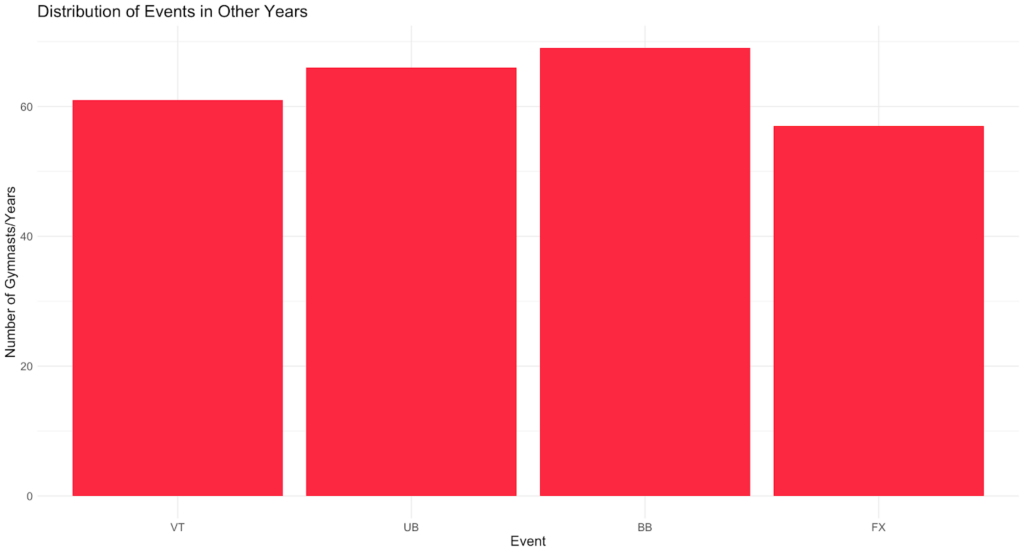
Examining the distribution of the specific events that these 60 gymnasts consistently competed in their seasons away from consistent all-around competition, we found it to be rather even across all four events, albeit with slightly lower numbers for floor and vault. Being more power-oriented events–and in the case of floor, often more demanding from a stamina and endurance perspective–this could suggest that one reason gymnasts step away from all-around competition is to preserve their bodies, particularly if they have already had lengthy and physically-taxing gymnastics careers prior to college.
When considering the 60 gymnasts with a mix of all-around and non-all-around seasons in their career, we were also curious about their performance in their all-around seasons, relative to their non-all-around seasons. In the charts below, the red and pink boxplots show the distributions of the season averages/highs of the gymnasts in their all-around and non-all-around seasons respectively.
In general, gymnasts performed better in seasons in which they were consistent all-around competitors, with the largest differences observed for season averages on bars and floor, and season highs on vault and bars, where the medians of the distributions were about 0.05 higher for the all-around seasons. There also tended to be less variance in the season averages/highs in the all-around seasons, as indicated by the red boxplots being flatter than the pink ones.


Conclusion
Overall, the analysis shows that while consistent all-arounders are relatively rare in college gymnastics, those who consistently compete in the all-around for at least one season tend to be mainstays in their teams’ lineups across multiple events, even when they take the year off of consistent all-around competition. Moreover, these gymnasts tend to perform slightly better in the seasons in which they are consistently in the all-around, though there is no way of knowing if their higher scores are due to, the cause of, or causally independent of their consistent presence in the all-around in those seasons.
READ THIS NEXT: Data Deep Dive: Hometown Heroes
Article by Dara Tan