Every NCAA gymnastics team can put up six athletes per lineup. Coaches must then strategize how to create those lineups. Should they rely on a few consistent athletes competing in several events, or do they let specialists shine in just one or two? Teams must balance maximizing the talent on their rosters with protecting athletes’ health and well-being. Our data team decided to do the math: which teams utilized the most, or the least, of their rosters in 2026?
Data editor Emma Hammerstrom used Python to scrape RoadToNationals, compiling rosters, final rankings, and individual gymnast scores for every NCAA team in 2026. Iowa State was excluded due to its shortened season. She then calculated the following for each team: how many unique gymnasts competed in at least one meet, the percentage of the roster they made up, and the average number of events they competed in. She then organized the data by conference and final ranking.
Which Teams Maximize Every Routine?

Every single gymnast on Denver’s roster competed at least once in 2026, a 100% utilization rate that reflects a small but efficient program. Fisk followed close behind, with 92% of its athletes competing at least once in the program’s final season. Fisk and Denver had two of the smallest rosters in the NCAA, with each gymnast competing in two to three events on average. UW-La Crosse used 88% of its 26-athlete roster at some point during the 2026 season.
Who’s Relying on the Same Faces Every Week?
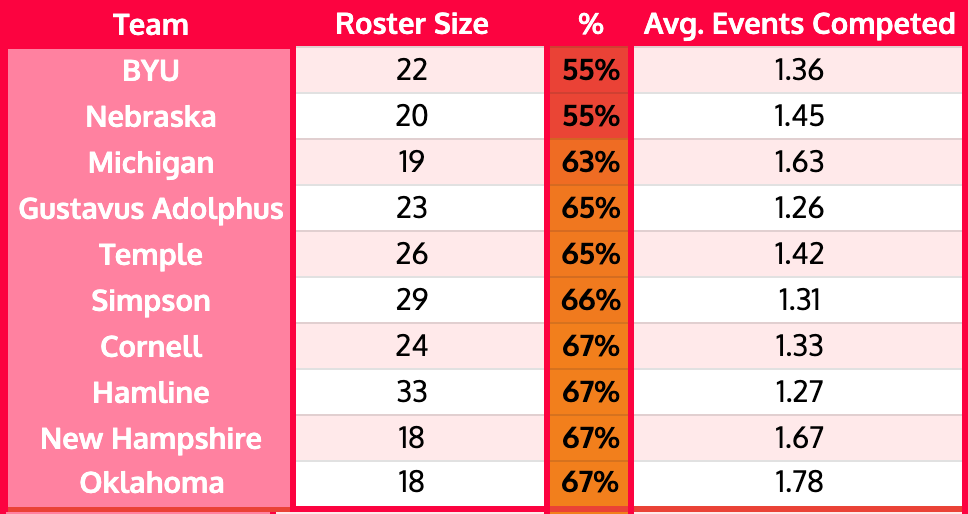
BYU and Nebraska each used just over half of their rosters in 2026, with athletes contributing one to two events on average. Both programs have hired new leadership for 2027, but whether the incoming staff will shift approaches to roster management is up in the air. Hamline had a large roster in 2026, which explains why only two-thirds of its roster saw competition time. Oklahoma stands out on this list, using only two-thirds of its very talented roster in 2026. Head coach KJ Kindler is known for building lineups around strong all-arounders. This strategy still delivered a national title in 2026, even with standout Addison Fatta only competing on beam due to injury.
[ad1]
Is there a correlation between roster utilization and the average number of events that a gymnast competes in?
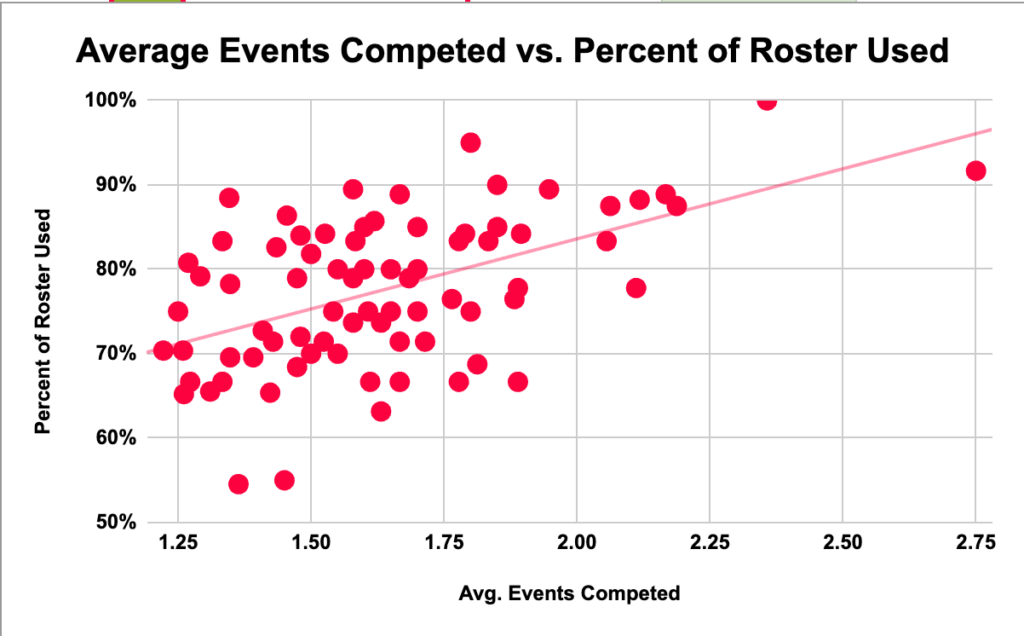
Somewhat. There is a weak positive correlation between the percentage of the roster used and the average number of events a gymnast competes in. Denver and Fisk skew the data slightly, as their small rosters required higher individual contributions. This positive correlation may be driven by coaches of smaller rosters who rely on versatile gymnasts capable of contributing across multiple events. In comparison, coaches with larger rosters have a deeper pool to draw from when building lineups.
Does heavier roster usage translate to better scores?
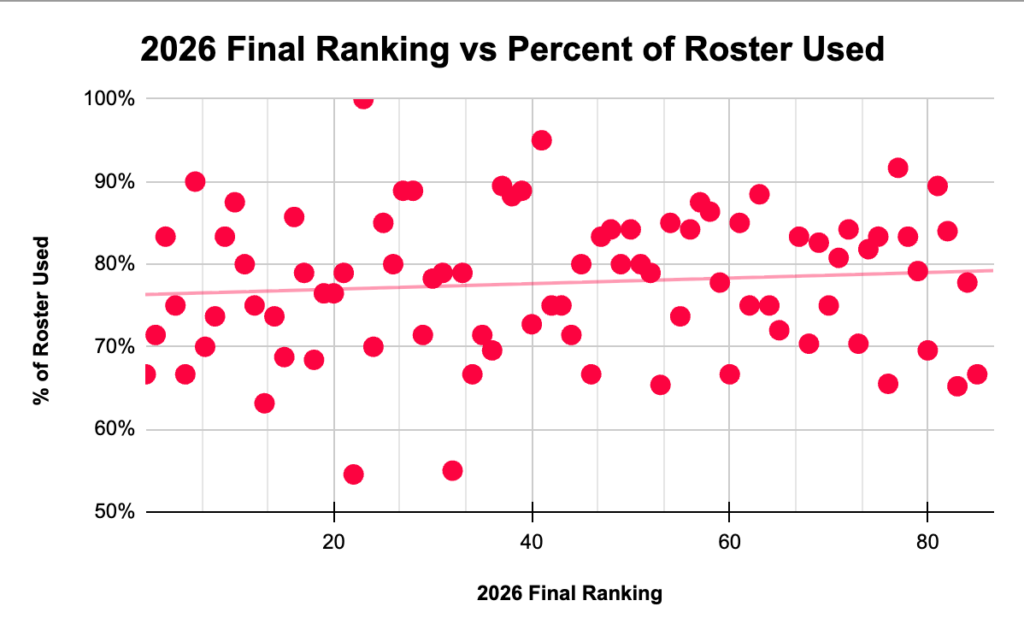
No. When looking at the data visually, there is virtually no correlation (R2 = 0.009) between ranking and the percentage of their roster used. Notably, teams that finished in the top twenty had roster usage rates between 63% and 90%, suggesting substantial variation in roster usage among the highest-performing teams. The same applies to teams that finished below 60th, which used anywhere from 65% to 92% of their roster.
READ THIS NEXT: Way Too Early Predictions for the 2027 Season
Article by Emma Hammerstrom