Seasons come and go, but the discourse around scoring never seems to cease. Fans have long questioned whether judges score differently across conferences, between sessions of the same meet, and perhaps most glaringly, between home and away competitions. Our data team set out to answer that hot-button question through the lens of the 2026 season: Which teams scored their best at home, and which held their own on the road?
Data editor Emma Hammerstrom compiled all scores from the 2026 regular season (excluding conference championships and the postseason) and organized all team scores by home or away. Neutral sites were counted as away meets for the purpose of this analysis, and readers interested in home team advantage at neutral sites can refer to our prior Data Deep Dive exploring this aspect. After analyzing the data, Division II and Division III teams were removed, given a significant number of outlier meets. Iowa State was also removed, given its shortened season. She then calculated average and maximum scores for each team, sorted by home or away meets.
Largest Home Advantages
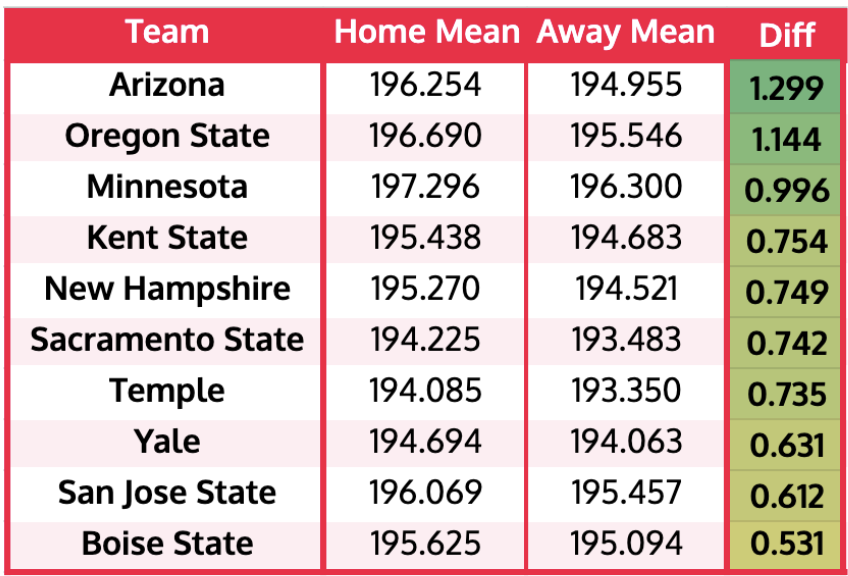
The ten teams with the largest average differentials all scored more than half a point higher at home than on the road. Arizona showed the widest gap of any team in 2026, averaging just a 194.914 away from home while frequently scoring above 196.000 in its home arena. Oregon State wasn’t far behind, with over a full point separating its home and away averages. Notably, Minnesota is the only team on this list that finished inside the top 20. Many of the teams with the largest discrepancies, including Yale, Sacramento State, and Temple, did not qualify for the postseason.

When looking at maximum scores rather than averages, Oregon State leads the pack. Its home maximum of 197.250 topped its best away score by 1.100 points. Arizona and Air Force follow closely behind, each with home maximums that outpace their road bests by nearly a point or more. Interestingly, North Carolina actually scored better on the road on average, but its maximum road score is almost five tenths lower than its maximum home score. At the other end of the list, Yale, Iowa, and North Carolina show smaller gaps, though multiple tenths are often meaningful in a sport decided by thin margins.
Largest Road Advantages

Not every team fed off home crowd energy in 2026. For some, the excitement of a road meet actually boosted performances. Eastern Michigan leads this group with the largest away advantage, averaging 0.636 points higher away from home than on its own floor. UC Davis and Illinois State follow, each averaging nearly half a point better on the road. Maryland is the highest scoring team on this list, averaging over 196.000 when competing on the road. At the other end, West Virginia, Rutgers, and Northern Illinois show only marginal away advantages, with differences under two tenths. This may suggest that those gaps fall within a normal meet to meet variation, rather than reflecting a truly significant road boost.
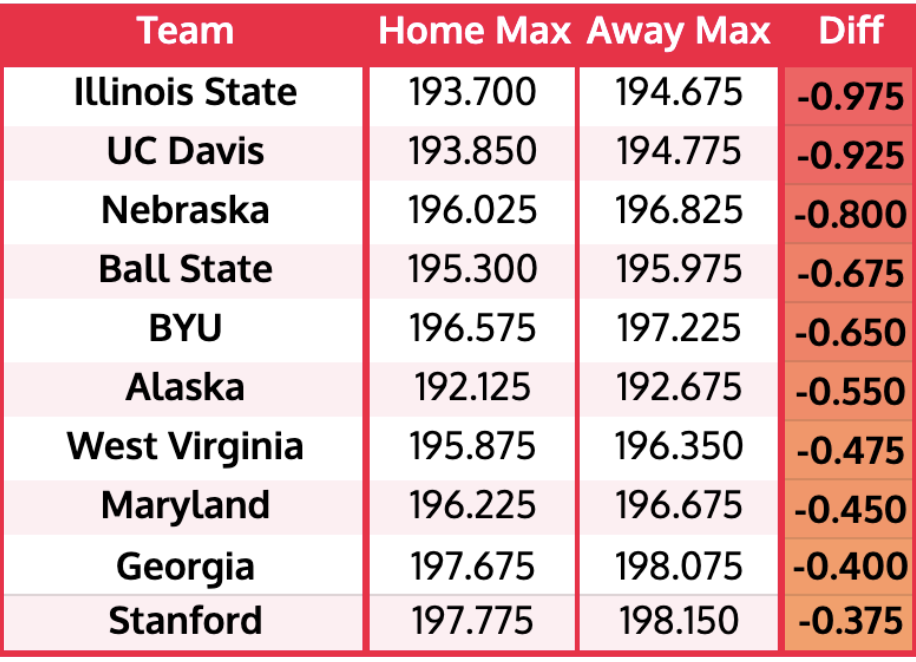
Illinois State and UC Davis had the largest discrepancies in maximum scores, each posting road bests nearly a point higher than their home ceilings. This is consistent with their away-leaning averages, and suggests that these programs genuinely perform better on the road rather than benefiting from a single outlier meet. Nebraska and BYU are notable inclusions, both capable of cracking 196 or better when competing on the road. Georgia and Stanford stand out as elite programs that peak above 198 on the road. Interestingly, their gaps are among the smallest here, perhaps a sign that they simply perform at a high level everywhere, rather than struggling at home.
The data proves that where a team competes can matter just as much as how it competes. For programs like Arizona and Oregon State, home meets came with a measurable scoring boost. For others, the road was no obstacle at all. The gaps documented here are not just statistical noise. In a sport where tenths decide postseason bids, half a point can be the difference between qualifying and watching from home.
Read this next: Winners and Losers of the New NQS Formula
Article by Emma Hammerstrom