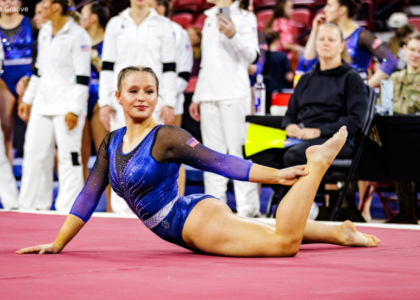
While the headlines in collegiate gymnastics are often dominated by the perennial DI powerhouses, a noticeable shift is occurring in lower ranks. Gymnasts from these programs are competing difficult routines with good execution and setting new program records weekly. In this edition of Judge’s Inquiry, I will re-evaluate these routines and break down the technical deductions and start values to see how these record-setting performances hold up under a second look.
Abby Royer (Southern Connecticut), Floor
Analysis: This was a very well-performed routine; Royer made her skills look easy and comfortable. The last pass was particularly satisfying, showing great height and a very clean finish. However, looking closely at the technical details, there were minor issues with the piked body shape on the front layout and some questions regarding the precision of the jumps. While it was difficult to see the exact foot positioning and floor contact from this specific video angle, the rotation and precision of the dance elements would likely incur a small deduction.
The Breakdown:
- Pike body shape, front layout: 0.050
- Rotation/precision of jumps: 0.050 to 0.100
Final Verdict: Original Score: 9.950 | Judge’s Inquiry Score: 9.900
Lindsey Yang (Brown), Beam
This routine is exceptionally difficult. A double wolf turn is an E-level skill in college, and Yang successfully executed a triple. She follows that with another E acro skill—a beautiful, flawless Onodi. Her leaps were stunning. She has seven tenths in bonus and only needs six, meaning she could actually remove her isolated split half and still start from a 10.0. Technically, the only deductions I saw were a slight knee bend during the wolf turn, a tiny adjustment on the split half, and a lean on the dismount.
The Breakdown:
- Knee bend on wolf turn: 0.050
- Precision on split-half (movement of feet): 0.050
- Lean on dismount landing: 0.050
Final Verdict: Original Score: 9.925 | Judge’s Inquiry Score: 9.850
Grace Murray (Ithaca), Vault
Analysis: The judging panel’s score here is quite surprising. While this vault may look strong in isolation, when compared to the height and dynamics of other front handspring front salto vaults in the NCAA, it appears a bit flat. Murray uses her momentum to create great distance and rotation, but she lacks the “pop” off the table that judges prioritize on this event. Her technique involves a significant shoulder angle and an arch on the table to generate power, which are both clear deductions. Despite a great landing, the technical faults during the pre-flight and on the table significantly lowered the total.
The Breakdown:
- Arch on the table: 0.100
- Shoulder angle on the table: 0.150
- Knee bend on the table: 0.050
- Lack of height in post-flight: 0.200
Final Verdict: Original Score: 9.800 (9.9 SV) | Judge’s Inquiry Score: 9.400
Kaylee Bateman (Winona State), Bars
Analysis: Bateman brings legitimate high-level difficulty to the uneven bars, highlighted by a huge piked Jaeger (E release) connected directly into a shoot-over. It is an aggressive and impressive sequence. However, the routine suffered from general form breaks that persisted throughout the performance. Specifically, there was visible leg separation, bent knees, and flexed feet on nearly all of her major elements, which accumulated quickly under a more strict evaluation.
The Breakdown:
- General form: Leg separation, bent knees, and flexed feet on all major elements.
Final Verdict: Original Score: 9.800 | Judge’s Inquiry Score: 9.500
Maggie Slife (Air Force), Bars
Analysis: This routine is stunning and could easily fit into the lineup of any top-10 program in the country. Slife performs two E-level skills and carries two extra tenths in bonus. The execution is beautiful. The only deductions found were a slight leg separation on the Maloney (which is often hidden from the judges’ side-view) and a minor arch on her toe circle to handstand.
The Breakdown:
- Leg separation on Maloney: (Deduction taken, though potentially not visible from side angle)
- Arch on toe circle to handstand: (Minor deduction)
Final Verdict: Original Score: 9.975 | Judge’s Inquiry Score: 9.900 (likely a 9.950 from the side)
Kristina Jakubiak (UW-Oshkosh), Beam
Analysis: A huge shout-out to the Oshkosh beam squad; having three different athletes (Hannah Hughes, Ome Ellis, and Jakubiak) break or tie the program record in a matter of weeks is incredible. Jakubiak’s record-setting 9.875 was a great routine, though it had a few minor balance and rhythm issues. I noted a small rhythm break after the cat leap and a slight wobble following the full turn. Additionally, the landings on the front toss and the dismount were a bit low.
The Breakdown:
- Rhythm after cat leap: 0.050
- Low landing on front toss: 0.050
- Slight wobble after full turn: 0.050
- Low chest on dismount landing: 0.050
Final Verdict: Original Score: 9.875 | Judge’s Inquiry Score: 9.800
Diamond Cook (Wilberforce), Floor
Analysis: Cook delivers a very clean and well-executed floor routine with engaging choreography and clean tumbling. Interestingly, her biggest deduction is actually a compositional requirement. She is missing a D-value acro element, which triggers an automatic “up to the level” (UTL) deduction. Beyond that technicality, the execution was very strong, with only minor deductions for a landing adjustment, rhythm in her leap connection, and foot form on her switch leap full.
The Breakdown:
- Missing D acro element (UTL deduction): 0.100
- Landing on second pass: 0.050
- Rhythm in dance connection: 0.050
- Feet in switch leap full: 0.050
Final Verdict: Original Score: 9.825 | Judge’s Inquiry Score: 9.750
READ THIS NEXT: NCAA Gymnastics Power Rankings: Perfect 10s
Article by Rhiannon Franck
Rhiannon Franck is a former national-rated NAWGJ women’s gymnastics judge with over 15 years of USAG judging experience and nine seasons judging NCAA gymnastics. Outside of gymnastics, Franck works at a university as a nursing professor and loves to travel.