Front double full is a popular skill for NCAA athletes, especially those only doing a two-pass routine. Valued at an E, this skill can be directly connected to another front salto or dance element, racking up difficulty and connective bonus, as well as fulfilling special requirements. How can you tell which ones are well-executed? In this article, I’ll show three examples of a front double full and describe some of the deductions.
Here are the most common deductions judges could apply:
- Amplitude (up to 0.2)
- Bent legs (up to 0.3)
- Leg separation (up to 0.2)
- Legs crossed (up to 0.1)
- Foot form (0.05)
- Incomplete twist (up to 0.2)
All landing deductions, including uncontrolled steps forward, steps backward, and body position deductions also apply.
The Ideal: The gymnast should rise off the floor, execute a tight twist with good leg form, and land square to the corner with a controlled step forward or rebound into the next skill. The twist should be completed before landing.
Floor Front Double Fulls
Good Example

Take Off
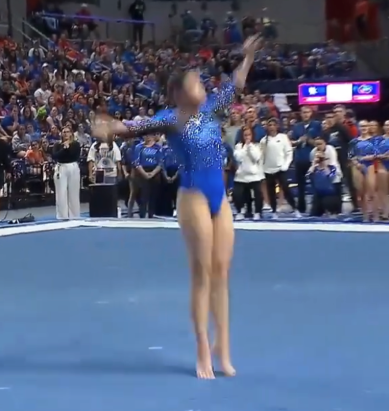
In Air

Leg separation (0.05)
Leg bent (0.05)
Height (0.05)
Landing

As with many of these high-level skills, if they aren’t performed well, the gymnast will struggle to land the skill or perform the connection following the skill. In this example, the gymnast clearly completes the skill, but she has some obvious leg form and lands back on her heels a bit, a sign of a slight underrotation or not enough height. In this example and the next, both gymnasts drop their shoulder and initiate the twist right off the floor. This technique can help them twist faster and longer, but they often sacrifice height to do so.
Great Example

Take Off

In Air

Crossed legs (0.05)
Height (0-0.05)
Landing

Incomplete twist (0-0.05)
I am definitely struggling to find deductions beyond the crossed legs, but compared to the next example, she doesn’t have quite the height or precision in the twist. Although I doubt these deductions would be taken, in an ideal judging world, they would be so that those who are able to perform the skill even better are rewarded.
Excellent Example

Take Off

In Air

Landing

Her front double full is very floaty and has more height than she needs. Her form is beautiful, and her twist is well-timed. Her landing is controlled, and her front tuck has a nice hip rise as well.
READ THIS NEXT: Judge’s Inquiry: Good vs. Great vs. Excellent Tsuk-Entry Vaults
Article by Rhiannon Franck
Rhiannon Franck is a former national-rated NAWGJ women’s gymnastics judge with over 15 years of USAG judging experience and nine seasons judging NCAA gymnastics.