The shoot over, also known as a bail or an overshoot, is a commonly performed transition from the high to low bar, but its evaluation can be very tricky. This skill can be awarded B, C, or D value part credit, depending on the preceding skill and the angle of arrival. To help you figure out how it’s credited, I made a decision tree:

Once you’ve determined the correct value part, you’ll need to evaluate how well it was performed. These are the most common execution deductions judges could apply:
- Amplitude (up to 0.2)
- Body position (up to 0.2)
- Leg separation (up to 0.2)
- Bent arms in support (up to 0.3)
- Angle of arrival 11 to 20 degrees from vertical (up to 0.05)
Amplitude is measured once the gymnast has caught and shown support on the low bar. Shoot overs must catch in horizontal or above to avoid an amplitude deduction. To measure the amplitude when a gymnast isn’t in handstand, look from the shoulders to the midpoint of the lowest point of the body. This is often their feet, but it could also be their torso if the gymnast is arched. Shoot overs to handstand should finish within 10 degrees of vertical to receive no deduction. Those finishing between 10 and 20 degrees incur a half-tenth deduction but are still given D credit. Shoot overs finishing below 20 degrees but above horizontal receive no amplitude deduction, and those finishing below horizontal incur an up-to-two-tenths amplitude deduction.
Confusing? Don’t worry. I’ll give you some examples below to help illustrate these different points. For most NCAA routines, just remember: If it goes to handstand, it’s worth D credit, and if it’s coming from a release, it’s given C credit.
The Ideal: An ideal shoot over, regardless of the value part, should show a clean, straight body position throughout the transition from high to low bar. The half turn should be completed prior to catching the low bar. The gymnast should catch the low bar in a tight, extended body position with straight arms prior to breaking their hips to prepare for the next skill.
Shoot over from a swing
Good Example

Arch (0.05)
Arm bend (0.10)
Leg form (0.05)
Amplitude (0.05)
This angle makes it tricky to evaluate the amplitude, but if the gymnast never passed through vertical, this would be given C credit. However, it does look like she’s within 20 degrees of handstand. Based on this angle, I would give the skill D credit but deduct for amplitude. Often in NCAA judging, if the judgment call is unclear, the judges will give credit for the higher-level skill and take execution deductions, rather than devaluing the skill, which impacts the start value and makes the score more likely to be inquired.
Great Example

Leg separation (0.05)
Arch (0.05)
In this example, I wanted to show that just because the gymnast missed her connection, she would still receive D credit for this skill. However, the extra swing incurs an automatic three-tenth deduction.
Excellent Example

Here, you can see excellent extension and a graceful landing on top of the bar in a clear handstand position.
Shoot over following a single bar release (C value part)
Good Example

Arch (0.05)
Bent arms (0.10)
Leg separation (0.05)
In this example, the gymnast doesn’t quite get the amplitude she needs to easily clear the low bar out of her Jaeger and ends up in a poor body position when she catches the bar. Although it’s still well above horizontal, she has some major form issues on the catch.
Great Example
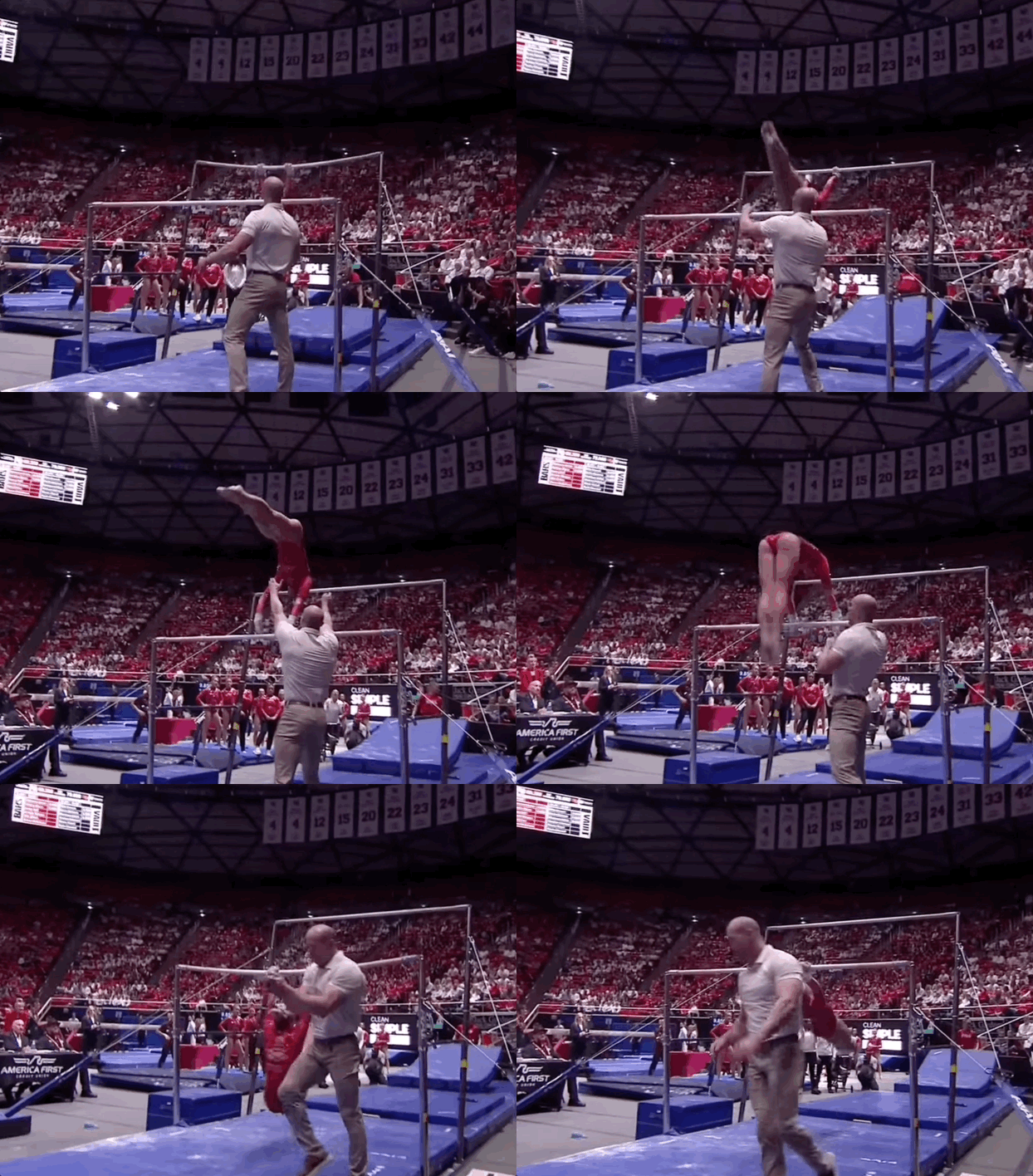
Body position (0.05)
Again, although the gymnast doesn’t have the most amplitude, she exceeds the minimum requirement of horizontal. However, her body shape is a bit closed on the catch, and her body arches to absorb the impact of the release.
Excellent Example

This shoot over is an example of a D-value part following a release. Although the gymnast catches slightly in front of the low bar, she easily controls the movement, passing through vertical and controlling her body into the next skill. Depending on the degree of arch on the catch, some judges may take a deduction. However, from this angle, it’s hard to tell.
READ THIS NEXT: Judge’s Inquiry: Good vs. Great vs. Excellent Ring Leaps and Jumps
Article by Rhiannon Franck
Rhiannon Franck is a former national-rated NAWGJ women’s gymnastics judge with over 15 years of USAG judging experience and nine seasons judging NCAA gymnastics.