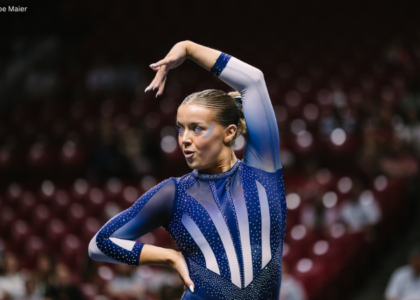
We wanted to know: Have older siblings or younger siblings seen more success in college gymnastics? We created a list of siblings and dug into the data to find out.
We started by creating a list of siblings. We only included gymnasts who had the opportunity to compete for at least four seasons between 2010 and 2025, so that we would be comparing the full careers of each sibling. For example, a junior in 2010 would be excluded, as would a junior in 2025, since their four years do not fall completely within the time frame.
Gymnasts who shared both a last name and a hometown were counted as siblings. We checked each potential sibling group and removed groups that were not siblings to the best of our knowledge. Siblings with different last names or different hometowns listed on their rosters were excluded in this method. Therefore, this is not a perfect count of siblings.
We also excluded twins, since we wanted to consider gymnasts who had at least one year of experience before another sibling as the older sibling. If a family had more than two siblings, the second and third siblings to start their careers were both considered to be younger siblings.
First, we compared the results of all older-sibling gymnasts to the results of all younger-sibling gymnasts. We found 17 pairs of siblings where one sibling had scores and the other did not. Of these 17 pairs, 10 had only the older sister compete, and seven saw only the younger sister compete.
Who Competes the Most Routines?
Older siblings competed more routines than younger siblings did. Over the fifteen years of data we analyzed, older siblings contributed 303 additional scores on vault than younger siblings, 415 more scores on bars, 195 more scores on beam, and 701 more scores on floor. Older siblings also competed in the all-around 281 more times than younger siblings. One potential reason for this discrepancy is that due to the time frame we analyzed, younger siblings were more likely to have competed in the 2020 and 2021 seasons which were affected by COVID-19 cancellations.
Who Has the Highest Scores?
Despite competing less frequently, younger siblings had higher mean and median scores on every event. The differences were less than or equal to 0.05. Median uneven bars scores were equal for both groups (9.75). The table below shows mean and median scores for each event.
| Older Siblings | Younger Siblings | Difference | ||
| Vault | Mean | 9.66 | 9.7 | 0.04 |
| Median | 9.72 | 9.75 | 0.03 | |
| Uneven Bars | Mean | 9.61 | 9.63 | 0.02 |
| Median | 9.75 | 9.75 | 0 | |
| Beam | Mean | 9.59 | 9.61 | 0.02 |
| Median | 9.72 | 9.75 | 0.03 | |
| Floor | Mean | 9.61 | 9.66 | 0.05 |
| Median | 9.72 | 9.75 | 0.03 | |
| All Around | Mean | 38.48 | 38.72 | 0.24 |
| Median | 38.67 | 38.95 | 0.28 |
Next, we compared median scores on each event among each group of siblings. We counted how often an older sibling had a higher median, and how often a younger sibling had a higher median. If only one sibling competed on an event, the sibling group was excluded from this part of the analysis.
On vault, older siblings narrowly outscored younger siblings. In 53% of sibling groups who competed on vault, the older sibling had a higher median vault score. On bars, younger siblings had a higher median score slightly more often. They outscored older siblings 51% of the time. On beam, older and younger siblings each had higher scores 50% of the time.
On floor and in the all-around, older siblings scored higher. On floor, older siblings outscored their younger siblings 56% of the time, and in the all-around, they did so 63% of the time.

Who Has Won the Most National Titles?
Lastly, we checked in on national titles. We found a tie: six titles won by older siblings and six titles won by younger siblings. Older sister Mackenzie Caquatto won two titles, one less than her younger sister Bridgette, both with Florida. Oklahoma has had two older siblings and one younger sibling on its winning teams: Keeley Kmieciak (2014 and 2016, older sibling of Lia Kmieciak), Stefani Catour (2016 and 2017, older sibling of Tara Catour), and Danielle Sievers (2022 and 2023, younger sibling of Meaghan Sievers). Lastly, LSU’s Aleah Finnegan (2024) won one title. She is the younger sibling of Sarah Finnegan.
Who Comes Out on Top Overall?
Older siblings came out on top in appearances, and siblings tied on national title wins. However, younger siblings had higher mean and median scores than older siblings on every event. For this reason, we’ll crown younger siblings as typically more successful than older siblings. The benefit of watching and learning from their older siblings may have given them a leg up.
Correction: This article originally missed Aleah Finnegan’s national championship. This has been corrected.READ THIS NEXT: Data Deep Dive: Oklahoma in Its First Season in the SEC
Article by Jill Walsh