Of the teams that made big leaps in the rankings this past season, some picked up quite a few additions to their rosters in the preseason, begging the question: to what extent were shifts in contributors related to ranking changes? To answer this question, we analyzed data on rankings and contributions to counting scores over the past two years.
Overall Trends
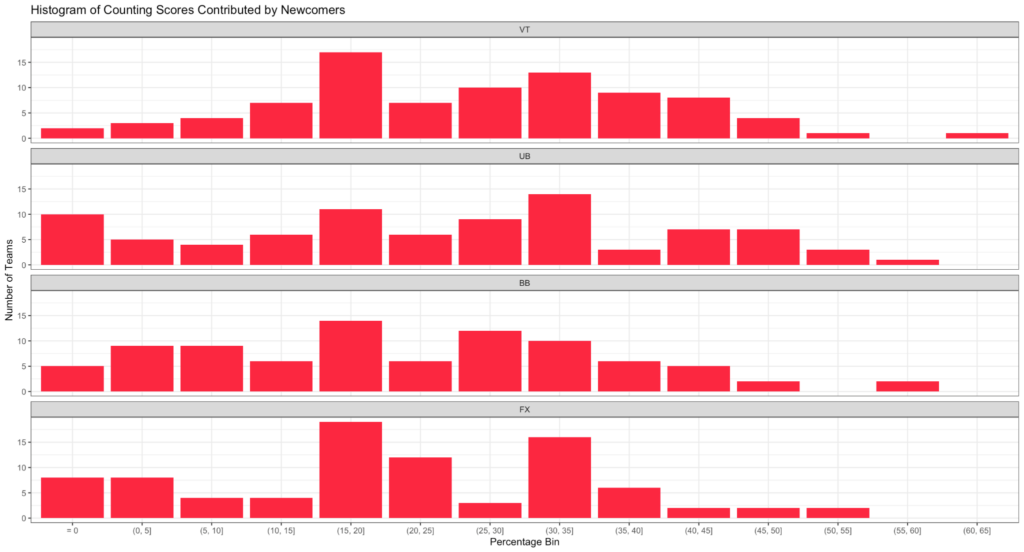
To start, we looked at the extent to which newcomers–that is, freshmen and incoming transfers–contributed counting scores to their respective teams. The chart below shows the distribution of the percentage of a team’s total (counting) score for the season that was contributed by newcomers. While the shapes of the distributions vary somewhat from event to event, in general, newcomers accounted for about a quarter of a team’s score, with means of 26.1% on vault, 24.6% on bars, 21.2% on beam, and 21.2% on floor.
On the other hand, the chart below shows the distribution of the percentage of a team’s score that was contributed by returning contributors–that is, returning team members who made lineups in both the 2025 and 2026 seasons. Again, while the shapes of the distributions vary slightly from event to event, the means were relatively similar, at just under 60% in 2025 and just over 60% in 2026. (The remaining 15 to 20% of counting scores were attributable to new contributors from among returning team members–gymnasts who remained on the same team across both seasons, but either debuted on or returned to an event after at least a season away.) In other words, looking at college gymnastics on the whole, returning team members who contributed scores in both years generally accounted for a slightly higher percentage of counting scores this past season than in the season prior.
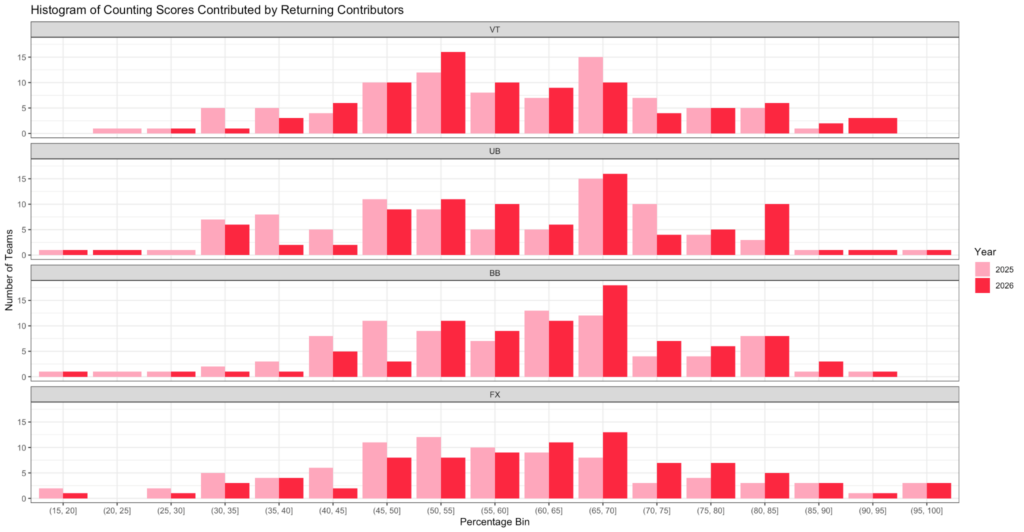
While the change in the mean percentage of counting scores contributed by returning contributors was rather small on each event, there were individual teams that saw much larger changes. On floor, for instance, Kent State saw a 41% increase, due in part to the promotion of Zoe Rankin and Nastia Rudnitskaya from occasional contributors (four meets each in 2025) to lineup staples (11 meets each in 2026). In contrast, Georgia saw a 31% decrease on the same event, with the previous season’s top contributor, Lily Smith, suffering an injury mid-season, and Csenge Bácskay only appearing in half as many meets in 2026 as she did in 2025. On the flip side of the GymDogs’ lineup shakeup, freshman CaMarah Williams took the top spot in terms of percentage of counting scores contributed; Harley Tomlin, returning team member but new contributor on the event, also made an impact, appearing in all 16 of Georgia’s meets in 2026.
Relation to Ranking Changes
With an overview of the extent to which the different groups of contributors accounted for their teams’ counting scores in mind, we then explored their relation to ranking changes. In doing so, we excluded Iowa State from our analysis, as the team’s season was cut short in 2026. They had an outlying ranking change that had the potential to skew our analysis.
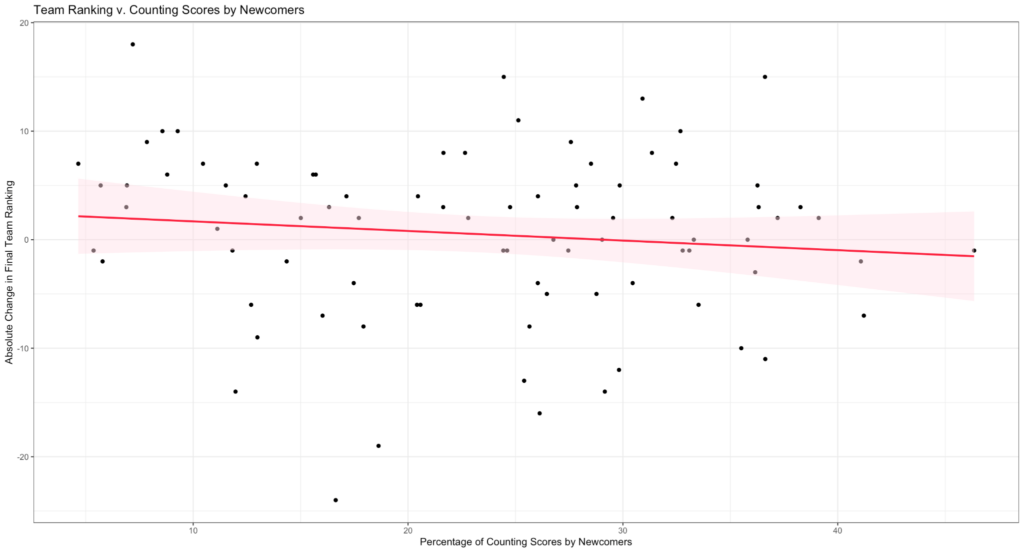
The chart above shows the change in a team’s final ranking from 2025 to 2026, against the percentage of the team’s counting scores that was contributed by newcomers across all events this past season. As shown, the relationship was negative, which might suggest that an overreliance on newcomers could hinder a team’s performance. However, this relationship was very slight (slope = -0.1), and teams had varying degrees of success with incorporating their newcomers into their lineups. In particular, despite all having high percentages of their counting scores contributed by newcomers, Illinois (37%) fell 11 spots in the rankings, San Jose State (37%) climbed 15 spots–tied for the second biggest jump, and Arizona State (46%, the highest percentage)’s rank stayed almost the same. Similarly diverse results were observed on the opposite end of the spectrum, among teams that barely utilized their newcomers.
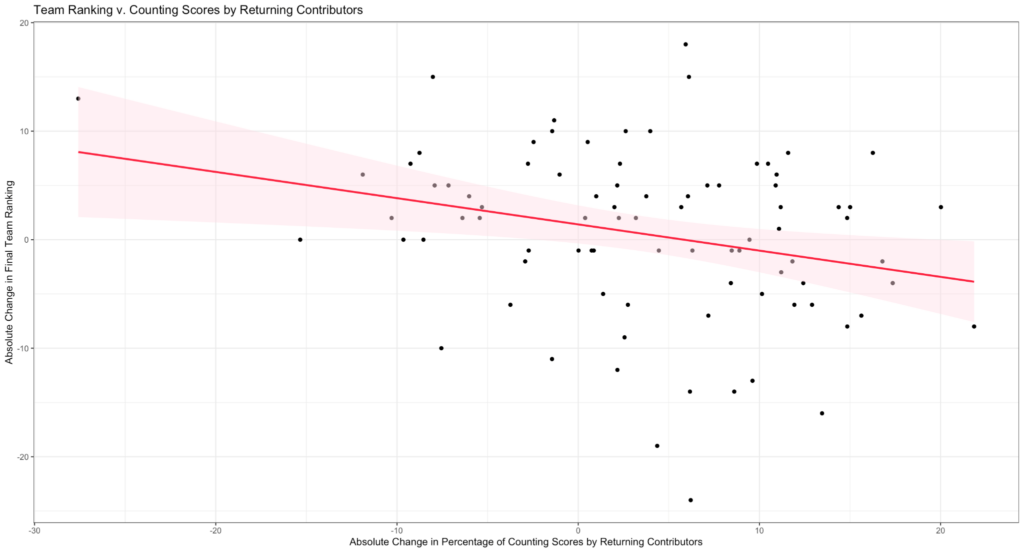
Turning to the returning contributors, we observed a negative relationship between the change in the percentage of a team’s counting scores attributable to returning contributors and the change in the team’s final ranking from 2025 to 2026. Although this relationship was weak (slope = -0.3), it could imply that teams whose lineups remained largely the same across both seasons were at a disadvantage compared to those who were able to introduce new contributors into the mix. As with the introduction of newcomers, however, teams saw a range of results when modifying their lineups from year to year: Georgia, with the biggest decrease (-28%) in the percentage of counting scores by returning contributors shot up in the rankings (+13), while Denver (-8%) regressed in the rankings table (-10); Missouri, with the biggest increase (+22%) in the percentage of counting scores by returning contributors slid back in the rankings (-8), but for Southern Connecticut, doubling down on returning contributors (+16%) improved their final standings (+8).
Discussion
Given the findings above, there appears to be some benefit to a team changing up its lineup from one season to the next, but only if the new contributors are composed of not only newcomers who might still be adjusting to the school or team, but also returning team members who are freshly capable of contributing on an event. In fact, anecdotally, the three teams that made the biggest leaps in the final standings this past season seemed to follow this idea–Air Force had substantial contributions from freshman Erin McDermott, but were also buoyed by returning team members Kylee Greene and Anna Bacott adding bars and floor respectively; while freshman Emma Malewski and transfer Ella Cesario were an important part of Clemson’s season, the addition of returning team member Brie Clark to the vault lineup was noteworthy as well; San Jose State leveraged a mix of contributions from newcomers such as Sophie Patterson, Genesis PeBenito, and Kaylee Larson, and debuts on vault/bars and floor by returning team members Samantha Macasu and Marissa Ashton.
That said, as we noted previously, the extent to which new contributors, and in particular newcomers, helped lift a team in the rankings varied across teams. While new contributors can certainly aid a team’s success, changes to a lineup are ultimately one of many factors that can influence a team’s final ranking and impact ranking shakeups as a whole.
READ THIS NEXT: Ranking Our Favorite Stick Celebrations of 2026
Article by Dara Tan